
Stuck on the Common App Essay? Stop writing around the real story.

Writing that essay—THE ESSAY—aka the personal statement for your Common App, just brings the pressure. Overwhelming. Daunting. A black hole. A roadblock. A dead end.
Oftentimes, students have an idea, and they write a draft, but it is so distant from the center of the story. They are circling around what it is they really want to say and, more often than not, need to stay with. But as humans, when we are stuck, well, it can be hard to get unstuck.
So if you are stuck on where to go with that essay—or with anything that may be keeping you stuck, like a disagreement with a sibling or parent, or where to begin to tackle that next project at work or school—there are three steps that I have found to be effective in helping students (and myself!) overcome the paralysis.
Step 1: Pause and Redirect (when encountering a roadblock)
First, acknowledge that it’s okay that this road has taken you so far and that it is no longer an option.
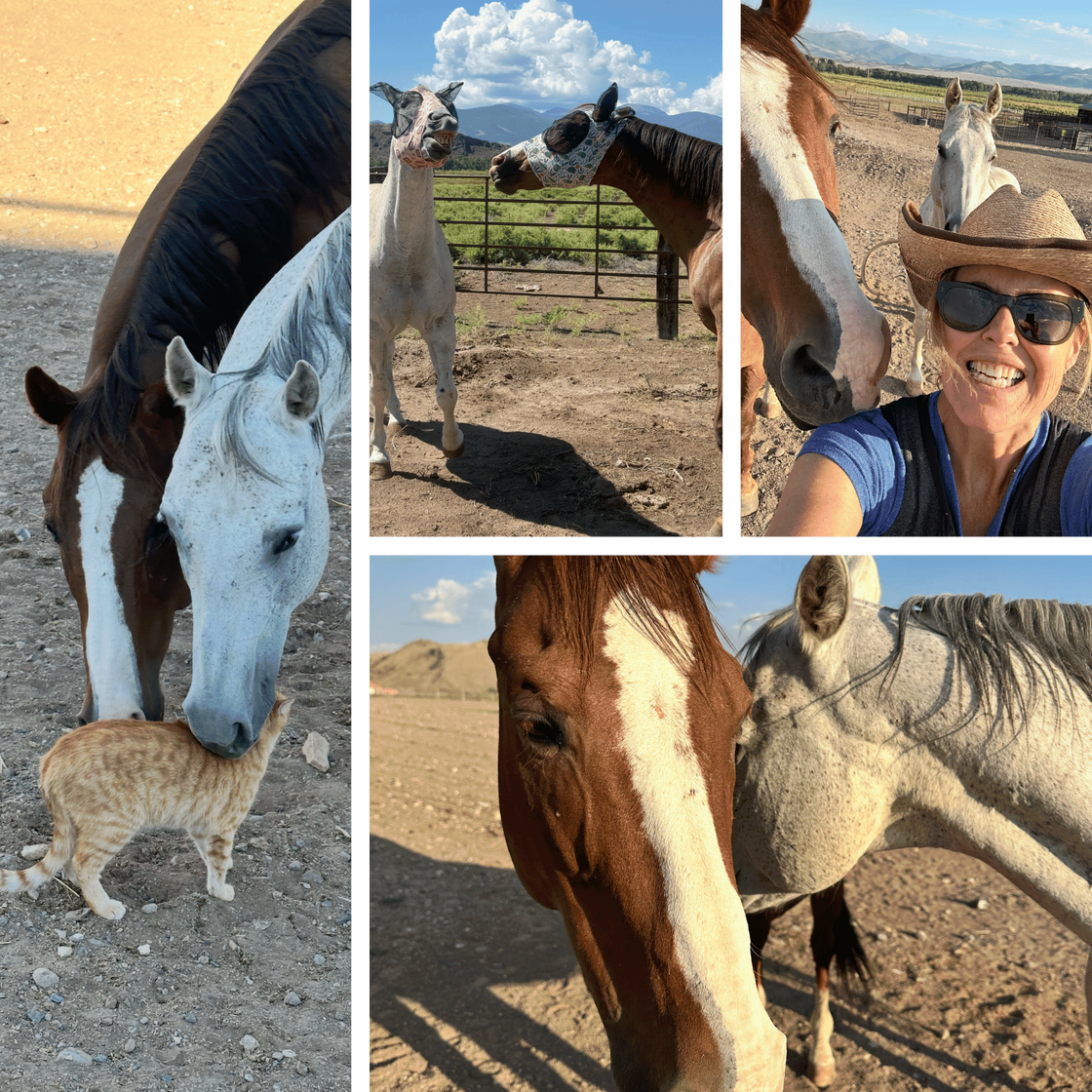
When this happens, it reminds me of my horses, Trey the rescue and Cash, new to the ranch. Sometimes when leading them, they just stop; they flat-out refuse to move forward. Nope, no can do.
When a 1,000-pound animal decides to stop and refuses to move forward, oftentimes my little old self is not going to be able to get them going again just by pulling on the lead in the same direction and talking to them. They may open their eyes wide, letting me know something is scary out there. Maybe Aspen ran around their backside. Maybe the garbage truck is pulling up the driveway to tip the dumpster. Maybe Turbo is working on keeping the prairie dog population in check with his 22.
They may pull up their heads and get “watchy.”
It is just not advisable to keep pulling and matching their ratcheting drama. Trey and Cash are strong and powerful prey animals, and if their instinct to protect themselves overrides their systems—well, things could end quite terribly for me.
The solution lies in a Pause and Redirect.
Students get “watchy” too. Rising seniors, when submitting their initial personal statement drafts, often find a topic they want to write about and then write around the edges of it. The center of one's story—what is at the core of it—is more often than not a vulnerable place.
That "watchy-ness" can often result in them questioning everything:
Am I allowed to say this?
What will someone think of me if I say the truth?
If I speak my truth? Is this what an admissions officer wants to hear?
Is this something that will help me earn an acceptance? Or will it hurt me?
This questioning makes them timid. In turn, they write in circles around what it is they would dare to say if they could just be honest.
At this stage of the writing process, what they are saying and what they are not saying are equally important in finding the redirect that will get them down an open road.
How do we do this? We lean into moments first.
Step 2: Start with Anecdotes
I ask students to think about moments that stand out to them related to their topic. A ten-year-old having to repeatedly restart The Lion King DVD for his brother with a developmental disability to settle him. A young girl playing Go Fish with her grandmother after school. A boyfriend who made a teenage girl feel less than when he called her awful names (this moment made such an impression on me; I wrote a post on it years ago). An RC car that was equally thrilling to fix as it was to speed down the road.
Students then write three 150–200-word anecdotes that share scenes like these related to their topic, bringing the story forward to the present day.
This snapshot approach creates a lot less pressure than taking on the entire personal statement at once. The anecdotes provide a launching point for digging deeper. Anecdotes are much easier to discard if we find that their tone or subject matter might not be appropriate to present. They are also easier to revise than tackling the entire essay.
Step 3: The Growth Thread
So then, we talk about them. We dive into the details of their anecdotes and talk about the underlying emotions.
Was it difficult to feel like you were “on call” to soothe your brother as a 7-year-old? What stories did you learn about your grandmother’s life playing cards? At what point did you decide that you were worth enough to break off the relationship? What classes in a mechanical engineering major interest you, given how much you like fixing things?
Talking through these moments helps a student verbalize their core values and lessons learned to date. The through line, the narrative arc, the “lesson” or the “point”—whatever you’d like to call it—naturally arises once the students give themselves permission to dive into these moments.
The core, the center, makes itself apparent in the details. It also makes for a memorable and engaging read.
And once it is there in black and white and we are talking about it, whatever was at the center that seemed too much to share or too much to write about feels a little less scary. The student can confidently choose the anecdotes that will land in the essay, and, in turn, the flow and narrative of the essay take form.
It is an honor to be entrusted with these details, to hear students share their experiences, and to consider how these have shaped them up to this pivotal stage in their lives.
Getting ourselves unstuck is a science and an art. It is something the universe tasks us with repeatedly in life. It is also what makes me feel most alive.
The getting unstuck.
Helping others find ways to get unstuck, whether they be students or rescue horses, helps me address the frustrating, stuck moments in my life with greater clarity and joy; it helps me get unstuck.
So, if Trey or Cash stops sharp, the lead line taut, I give them slack. Sometimes we just take a moment and consider our surroundings. I step to the side and pull gently in a different direction.
I ask them to consider an alternative trajectory.
Sometimes, we all need a pause and redirect.

0 comments
Leave a comment