
A Call for The Humanities (Part 2) — In the age of AI, Division & Distraction


Picking up where we left off: the courage to engage the "other" points to the humanities as our starting point.
A college degree has become largely transactional in the pursuit of a first-job guarantee. This leads large swaths of our young potential into fields that don't align with fulfilling lives, where they can discover who they are and what they came here to do.
In Excellent Sheep, the 2014 book by former Yale professor and now full-time writer, William Deresiewicz, he wrote pointedly about career services at elite universities. High percentages of graduates claw their way through recruiting for Wall Street or consulting positions, only to come up for air years later, wondering why they feel so empty. The skill set to build a resume for elite acceptance is, again, applied throughout the waning stretch of undergrad years to land that elite job. For some, it works well. For many, though, education, arts, public service, ministry, or entrepreneurship might have served better.
As reported by Robert Townsend, Director of Humanities, Arts, and Culture Programs at the American Academy of Arts and Sciences, humanities bachelor's degrees comprised 15% of all four-year degrees early this century. Today, that number hovers just over 8%. Funding for these departments is shrinking at an alarming rate. Yet David Brooks, when bidding goodbye to his long New York Times tenure, noted how pessimistic nihilism—with its chokehold on society—is prompting a "humanistic renaissance" on campuses. University leadership recognizes that the pendulum swung too far toward preprofessionalism. Many are rethinking, refocusing on a more balanced approach.
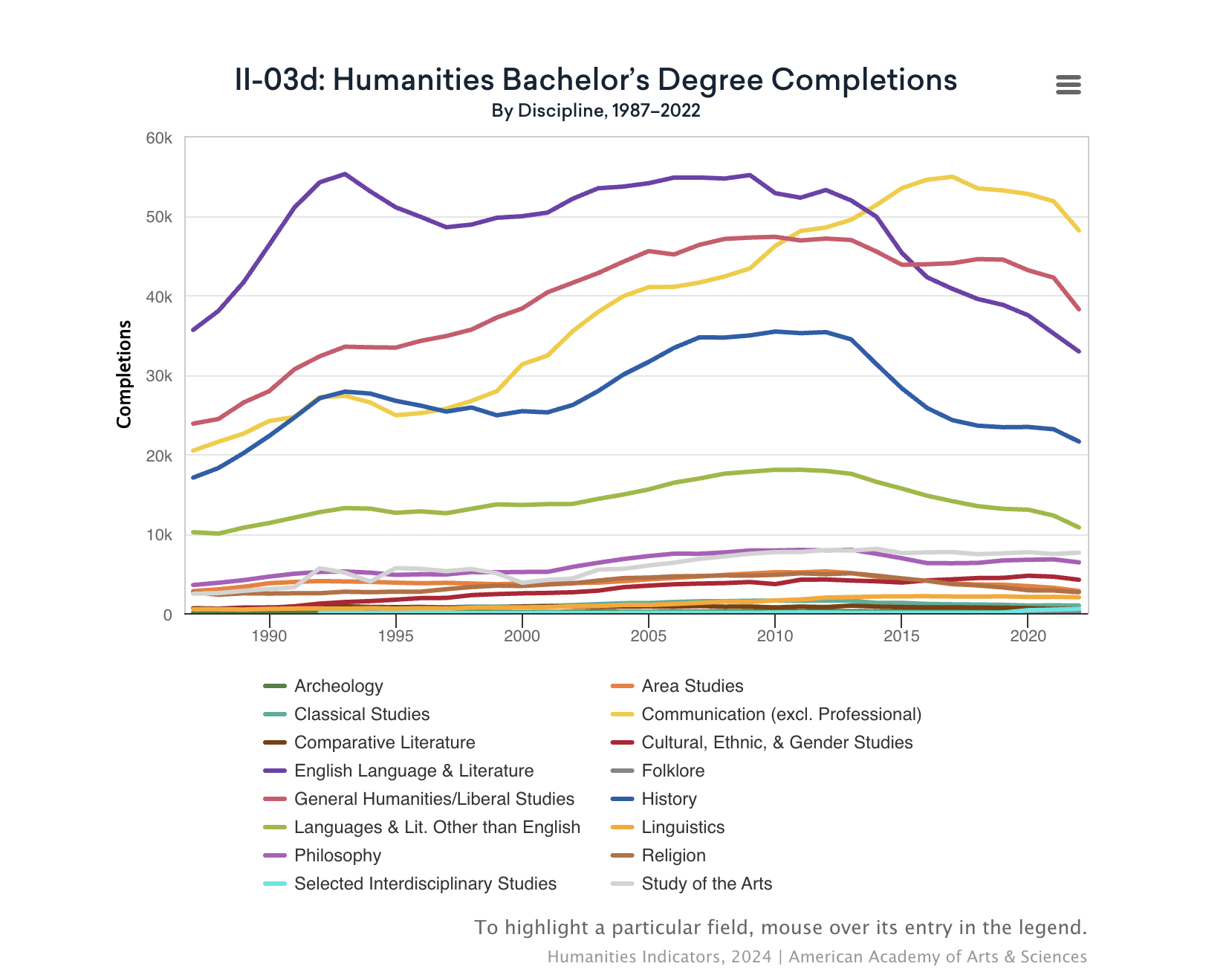
Source: American Academy of Arts & Sciences (Click the image to access the interactive features of the graph)
As we enter the AI age in the midst of a spike of political and social division, the study of our humanness, the conscious and deliberate opposition to the false notion of "other," is where we will need to find a path forward. It is also important to note that within our humanity lies our unique ability to hone and harness our intuition. There is no doubt that AI is upending the labor market and that new college graduates are finding it increasingly competitive to land a job.
In higher education, a particular major, especially if it is not what a student intrinsically embraces, will not train the best minds for next-generation issues. There will be no laundry list of sure-thing majors. Take the ultimate "sure thing": computer science.
- 2005-2022: CS degrees meant near-guaranteed jobs
- 2014-2023: Universities doubled enrollment
- Then AI hit: Automated entry-level coding.
- Layoffs: ~200K in 2023 (Amazon 16K, Google 12K, Microsoft 10K) + 100K more in 2025.
- Now: CS grads 22-27 at 6.1% unemployment vs. ~3% for biology/art history.
This radar graph, published by Anthropic, is a predictor of what occupations will be most impacted by AI. As you can see, the majority of the fields noted in blue are those that require, at a minimum, a bachelor’s degree.
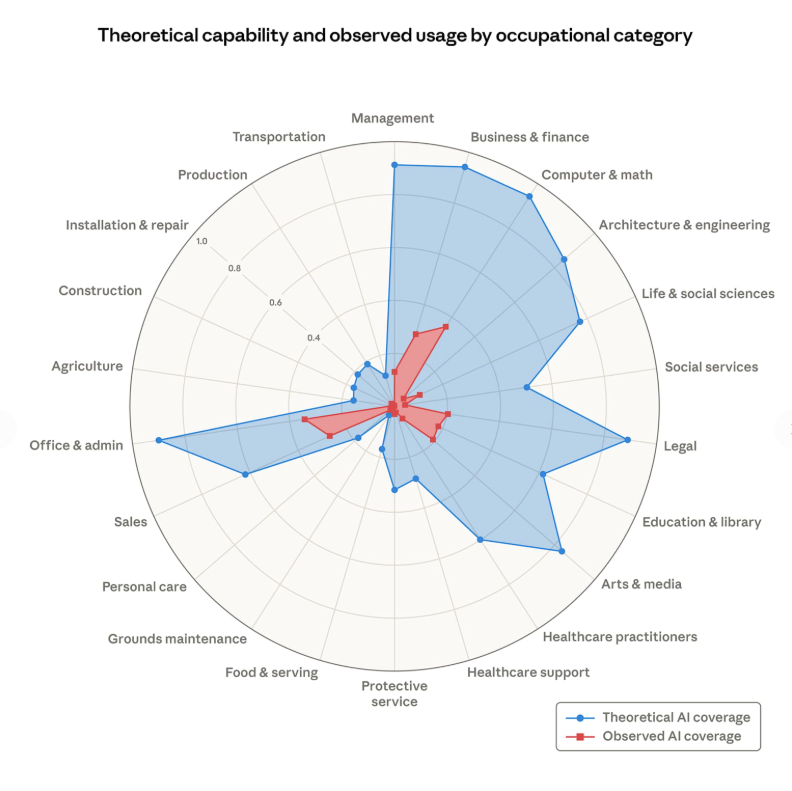
Source: Anthropic, https://www.anthropic.com/research/labor-market-impacts
Where does this leave those heading off to college?
One quote from Georgetown University’s Center for Education and The Workforce, The Major Payoff: Evaluating Earnings and Employment Outcomes Across Bachelor’s Degrees (2025) summarizes the angst that parents and students feel alike.
Selecting a major in the face of current uncertainties requires students to balance their personal interests and aptitudes against their earnings potential in a dynamic and unpredictable labor market. Choosing a major in light of these critical but occasionally contradictory considerations is no easy task.
This is the tension I see daily. We want our students to have both: work that pays the bills and work that aligns with who they are.
At Elevated Admissions, we start with the student, helping them see and articulate their “why,” and then, and only then, do we bridge those understandings to what that might look like in terms of majors, projected job openings, and earnings. It is one small attempt to be part of the solution rather than simply naming the problem.
I am hopeful that, out of this chaos, a collective return to the noble pursuit of seeing humans as humans, not as “other,” will arise. AI has tipped the chessboard, and all of the pieces are tumbling through the air. While we muddle our way through, what AI is not capable of doing well will become clear. Interdisciplinary initiatives that institutions like Rutgers, Princeton, WashU, and MIT, to name a few, are implementing are evidence that higher education is recognizing the need to shift its approach.
Institutions can change structures, but what each of us brings to that change is deeply human.
Our human superpowers lie in our ability to show empathy, think deeply, and utilize our intuition. This, in my opinion, is where the danger lies for all of us in our distracted society. Cal Newport, author of many best-selling books including Deep Work: Rules for Focused Success in a Distracted World, Digital Minimalism, and So Good They Can’t Ignore You, makes a strong case for the following to ensure success in today’s economy:
- Treat your brain as a muscle, and be careful: without deep work, it will atrophy.
- Ditch the passion mindset and adopt the craftsman mindset to become “so good they can’t ignore you.”
Deep work is one of those difficult things needing to be picked up. It means not using AI to write your papers for you. It means choosing to read an article or a book rather than doomscrolling. It means having those difficult conversations with others and remembering that we need to show up with a degree of “neighborism” despite our differences. This is the foundation of the idea of college, of having those four years to explore topics, meet the “other” on campus, and engage in conversation. Recognizing that, alongside potential earnings, there is a need to create citizens who are willing to participate in society.
Back at Clement’s Mine, the graphic scene I mentioned in the previous post is one where a slave is lashed to a picnic table and whipped. Her crime: letting a traveling salesman teach a young Black girl her letters. Mr. March witnesses it and does nothing.
Alex Pretti's crime was trying to help a peaceful protester stand after agents shoved her down.
Regardless of what degree you may or may not have, all of us must strive to engage in civil discourse. To the extent we pick up difficult conversations and find common ground—or just recognize, despite differing opinions, "I know you are not the 'other'—we return to collective human experience. It requires thoughtfulness, analysis, and temperance. Exercises befitting a human being.
It demands picking up difficult things.

0 comments
Leave a comment