
AP Exam Season: How to Study With Your Teen’s Brain, Not Against It

AP Exam Season: How to Study With Your Teen’s Brain, Not Against It
If you have a teen taking AP exams this spring, you’ve probably seen at least one of the following:
- Color‑coded binders that have not been opened since October.
- “Studying” that looks suspiciously like scrolling.
- A dramatic declaration: “It’ll be fine. I’ve got everything completely under control.”
Deep breath.
The goal of AP season is not to turn your home into a test‑prep boot camp. It’s to help your teen use just enough structure and science‑backed strategies for the work they’re already doing to actually stick.
That’s why we created the AP Exam Essentials one‑pager: quick, doable routines you can post on the fridge. Think of this as the “under the hood” look at the “why” behind the advice and how it plays out in real life.
Why Most “Studying” Doesn’t Stick (Hello, Forgetting Curve)
Here’s the un‑fun news: our brains are built to forget.
After your teen learns something in class, their brain holds onto a lot of it for a few hours. Within a day or two, if they don’t revisit it, memory drops off sharply—that’s the “forgetting curve,” and it’s not about intelligence; it’s just how human memory works.
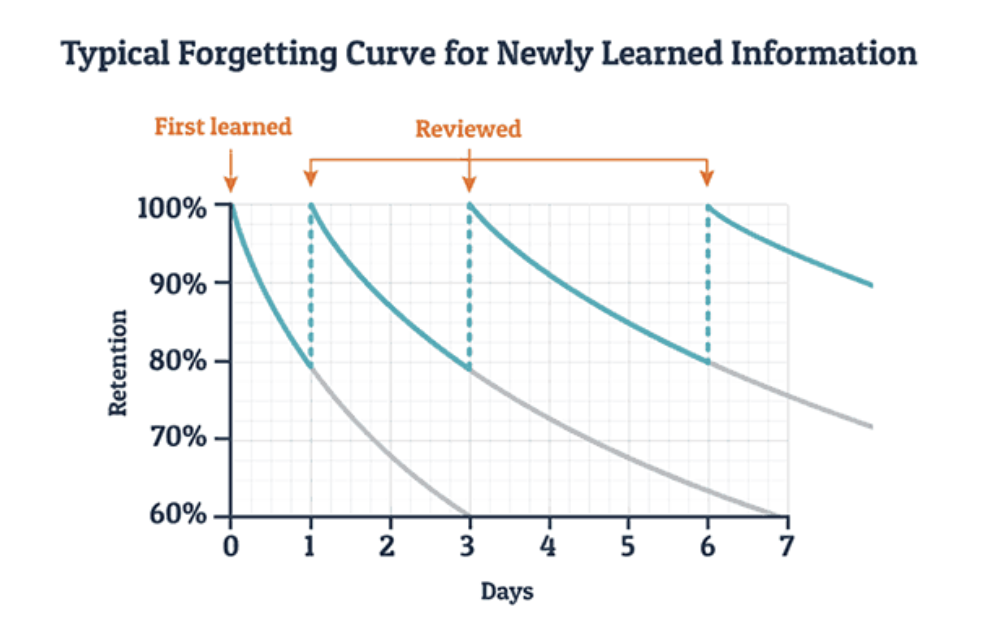
Graphic from https://www.educationcorner.com/the-forgetting-curve/
The fix is not “more hours at the desk.” It’s better timing and better use of those hours.
Every time your teen comes back to a topic and has to pull it up from memory, that memory trace gets stronger and lasts longer. Think of it like walking a path through tall grass: the first time, it almost disappears behind you; the fifth time, there’s a clear trail.
Our AP plan is basically: help your teen walk the right paths, often enough, without living in the field.
Why the Daily AP Drill Works (and Why We Keep Saying “Notes Closed”)
On the one‑pager, you’ll see a suggestion for a daily 45‑minute AP block that looks like this: close notes first, answer 3–5 self‑written questions from recent units, check with notes or Khan Academy, then practice only the weak spots and jot tomorrow’s focus.
Why this combo is so effective:
Self‑written questions = clear targets.
When your teen writes their own questions (“Explain how supply and demand affect price,” “Why did this historical event matter?”). They’re forced to decide what “knowing the material” actually means. That beats staring at a giant chapter thinking, “I guess I should memorize this?”
Answering with notes closed = actual learning.
This is called active recall—retrieving information from memory without looking—and it is one of the most well‑researched ways to strengthen learning. It also feels uncomfortable. Your teen might say, “I’m bad at this” because the answers don’t come out perfectly at first. You can reassure them: the struggle is the point. That brief moment of “Wait…what was it?” is their brain doing the heavy lifting that actually builds memory.
Checking afterward = fast course correction.
Only after they’ve tried from memory do they open notes, textbook, or Khan Academy to check and fix. Now, when they see the correct information, their brain has something to attach it to—a failed attempt they’re correcting—rather than a page they’re just skimming. That’s the difference between “Oh yeah, that looks familiar” and “I know this.”
Practicing only weak spots = efficient effort.
Instead of doing random problem sets, your teen uses those starred “I missed this” spots to choose practice questions. The hardest concepts get the most reps, and the easy ones don’t eat up time. Result: 45 minutes that actually move the needle.
If you want a simple parent script for this section, it’s: “Start with what you can remember without looking, then use your notes to fix anything you forgot.”
Why the Weekly Mini‑Mock + Spaced Repetition is Good Training for the Real Thing
The other anchor in the plan is a once‑a‑week “mini‑mock”:
Once a week, do 20–25 mixed multiple‑choice questions in 25–30 minutes, then one free‑response in the official time. When you’re done, sort every missed question into “content I didn’t know” or “careless/time.” Use that list to choose what you study next.
Why this matters:
- It makes the format familiar. The first time your teen sits with a ticking clock should not be the real AP exam. Short, timed practice shrinks the mystery and the nerves.
- It diagnoses the right problem. Missing questions doesn’t automatically mean “I’m bad at this.” Sometimes it’s “I misread the question” or “I panicked and rushed.” Sorting errors into “content vs. careless” tells your teen whether they need more knowledge, better pacing, or both.
- It writes their study plan for them. Instead of staring at six units and guessing where to start, they can look at their mini‑mock and say, “Okay, clearly I’m rusty on Unit 2, and I keep misreading graph questions. That’s what I’ll hit this week.”
This is where spaced repetition sneaks in. If they see Unit 3 in class, review it in a daily drill, then meet it again in a mini‑mock, they’ve now tugged on that memory three times, spread over days and weeks. By exam day, it’s not “I learned this once back in October”; it’s “I’ve seen this a bunch of times, in different ways.”
The good news: this doesn’t mean hours of extra work. Often, we’re talking about a weekly practice block plus a few 10‑minute check‑ins woven into what they already do.
Why the Parent Moves Matter (Without Becoming the Homework Police)
You’ll also see a “Parent Moves That Land” section on the one‑pager. These are intentionally small; you don’t need a second job as a test‑prep coach.
Study space and calendar = fewer friction points.
When your teen has one fairly quiet spot where studying usually happens and short AP blocks actually written on the calendar, their brain doesn’t have to negotiate, “Where should I go? When should I start?” every day. Fewer decisions mean more energy left for thinking. Your role: help set this up once, then protect it. “Hey, I see you’ve got ‘AP review’ blocked at 7. Do you want me to give you a 10‑minute warning before?”
Better check‑in questions = more learning, less nagging.
“How’s studying going?” tends to get you one‑word answers and eye rolls. Questions like “What were your two topics today?”, “Tell me one question you practiced and how you answered it,” or “What’s one mistake you caught and fixed?” prompt your teen to summarize what they did—a little retrieval rep—and keep the focus on effort and strategy, not just the eventual score. You’re not quizzing them; you’re helping them notice their own work and growth.
Modeling calm = better access to what they know.
High anxiety makes it harder to retrieve information, even when it’s in there. You can’t eliminate nerves, but your tone and routines can turn the volume down. Protect a reasonable bedtime, keep breakfast simple and predictable, and consider a low‑key evening (walk, family show, favorite dessert) instead of one more round of “Did you study enough?” When you stay steady and encouraging, you become the emotional “ground wire” they borrow calm from.
The Real Win of AP Season
AP exams matter, yes. But they are also a training ground. Your teen is learning how their brain works, how to manage big tasks over time, and how to show up for something that feels high stakes.
When you swap “more hours, more stress” for short, focused daily drills, occasional mini‑mocks, and simple parent routines that support (not smother), you’re not just chasing a score. You’re helping your teen build habits they can carry into every big test that comes next—SATs, ACTs, college finals, grad‑school entrance exams, big presentations, and all the rest.
And that’s why this little AP Exam Essentials Guide earns its spot on the fridge.

0 comments
Leave a comment