
The Conundrum of Deferral

Many elements of the admissions process are unpredictable; the decision to apply Early Decision I (EDI) or Restrictive Early Decision (REA) is a strategy that can help increase a student’s chances of admission, thereby, hopefully, making an acceptance much more predictable. Oftentimes, though—especially for institutions posting less than 20% admission rates, and even more so for those with single-digit rates—when a student receives a deferral, the next step becomes clouded.
The conundrum of being deferred from your top-choice institution often throws students into a frenzy. Once the student and their families digest the new reality (which is decidedly different from the reality they had been hoping for, envisioning, or convincing themselves they could accept if they received a denial—because, after all, there are other options out there), in sweeps the next posse of decisions to be made. Should I submit an EDII application? What if I get into my EDII and then am offered admission to my top choice? What about the acceptances I have already received that I thought I would never really go to? Is it time for me to start considering those other colleges, like, for real?
The rabbit hole of doubts, disappointments, hopes, fears, anxieties, and second-guessing can go quite deep. Here’s the thing: colleges’ deferral strategies can vary significantly. This, coupled with the fact that data on deferrals are not part of the Common Data Set, makes making a statistically-driven decision not straightforward. But with single-digit acceptance rates on the rise, the stats are increasingly against the applicant.
I am currently doing my best to help a student navigate through and out of this rabbit hole after receiving a deferral from Notre Dame. Let’s call this student John. One of our sessions went like this:
John: I know it is like super hard to get into, but I thought I had a chance, especially since I had that extra recommendation from a teacher who has a connection there.
Me: You did your very best on your application, and a deferral from Notre Dame is a signal from admissions that they actually consider you a viable candidate; they do reject a substantial number of REA applicants—about 70% each year, which is a larger percentage than some of their peer institutions.
John: I read in a thread that 20% of deferred applicants end up getting admitted. Honestly, I just wish I had been denied, then I would feel so much better about an EDII application. Do you think I still have a chance at getting in? I really want to go there.
Me: Of course, there is always a chance, but EDII is your best chance at attending Notre Dame or Boston College. The two share many similarities, and both offer an amazing education.
John: I just don’t know what to do because if I got into BC, that would be great, but then I would be disappointed if I got an acceptance from Notre Dame.
Take this conversation thread and multiply it by two, maybe three. I was getting a full-on tour of his rabbit hole.
What came to mind for me in listening to John was the fabulous introduction from Author Oliver Burkeman’s book, Meditation for Mortals: Four Weeks to Embrace Your Limitations and Make Time for What Counts. The book is organized into 28 bite-sized chapters of wisdom, with an invitation to read and digest one each day over the course of a month. It is a rare thing when an introduction is so powerful that it makes you want to read an excerpt of it to the person standing next to you in The Tattered Cover Bookstore in the Denver Airport. (Yes, I restrained myself.)
Burkeman straight-up claims he selfishly wrote the book for himself after many frustrated attempts at implementing someone else’s system of organization and productivity to, once and for all, get his life under control. His philosophy is one of “imperfectionism,” whereby accepting that life can be messy, with many elements out of control, allows us to navigate life with greater fulfillment and a whole lot less anxiety.
Verbalizing this conundrum was important for John as he began to recognize the loop he was in. And he also recognized that it was on repeat all day and all night as he fitfully slept. The dark circles under his eyes and the tension in his forehead backed up my assessment.
The notion that there is one and only one perfect school out there is part of the admissions kool-aid in the striving American collective consciousness, served up and bought into the kitchens and high school hallways, and exchanged between parents on the sidelines and at bake sales. Coronating a particular college is a risky proposition; yet with REA or Early Decision, this is exactly what 17- and 18-year-olds are being asked to do, and even encouraged to do. Early decision and restrictive early action are useful tools because, for many, this is the best strategy for gaining admission to a hyper-selective institution.
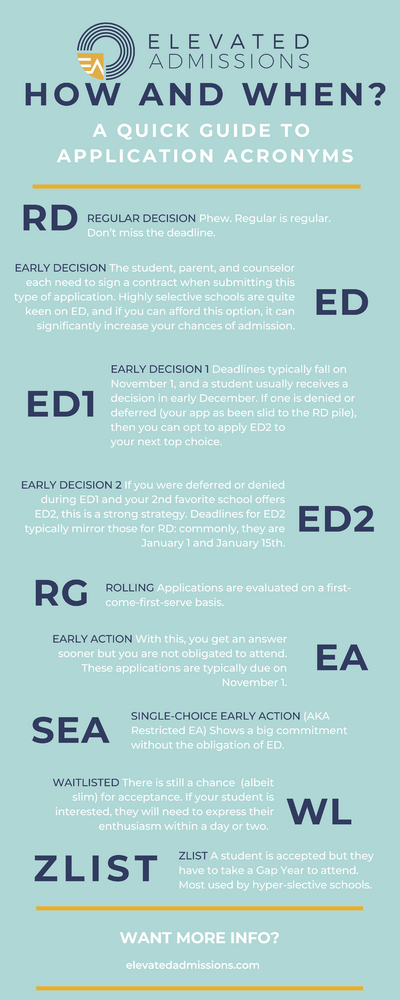
Before I delve into the nuances of application types and strategies, this post is not meant to be an exploration of that particular rabbit hole. (You can download our application type guide HERE.)
Let’s get back to John’s rabbit hole.
Because these moments—when an emerging young adult is spinning and scurrying down the rabbit hole, convinced that where they land for college will determine their entire life—are so important, it’s time to hit the pause button. This is a moment when we can help them see that the answers and the success don’t lie in a particular name. Instead, the answers and the success, and the fruition of their dreams, have been within their grasp all along, right inside of them. However, for them to begin to see that, they have to get out of their tailspin, recalibrate their nervous system, and give themselves permission to NOT have to figure this out right this very moment. It is also a moment to remind them to hone the powerful skill of self-regulation and the wonder that a bit of space and time can work. Muddied waters get muddier the more you stir them with a stick, looking for something. The only way to clear the water is to let the mud settle.
I smiled kindly at John and acknowledged his struggle. I asked him whether the constant conversation in his mind about making this difficult decision was helping him. No, not at all, I feel like I end up more confused than ever. John had been down the hole for over a week. The decision before him about whether to submit an EDII application had become entangled with all of the unknowns inherent in the admissions process.
A Shortlist of Questions I Asked – And You Can Use Too When Talking to Your Teen
- What acceptances do you have so far?
- If those were the only options available to you, how would you feel?
- Is there only one right option out there for you?
- How would you feel if you were denied at Notre Dame and hadn’t applied ED to Boston College?
- How would it change things for you right now if you could just stop thinking about this for even an hour?
- What would happen if, over the next week, every time you began to think about this, you repeated something else to yourself? A mantra, a pep talk, a prayer?
As for John, he decided to adopt a phrase to repeat to himself.
The following week, we met. John had decided to apply ED II. More importantly, though, he had clearly made peace with his decision and spoke about his current acceptances with excitement.
As the remaining decisions come out, I hope that if John doesn’t receive the news he is hoping for, he can take a step back and not dive down another rabbit hole. If he does, hopefully, he won't spend quite as much time there as last time.
P.S. Selfishly, I wrote this post for myself, because I need to revisit this life skill more often than I care to admit.

0 comments
Leave a comment